Localized Virtual Staging: 2026 Interior Rendering for Real Estate
In the high-stakes world of 2026 real estate, the "blank canvas" is officially a relic of the past. As buyers navigate an increasingly digital-first market, their first interaction with a property isn't on a sidewalk—it’s through a high-fidelity, AI-enhanced screen.
But here is the million-dollar mistake most agents and developers make: treating virtual staging as a "one-size-fits-all" aesthetic.
If you are staging a glass-walled penthouse in Miami with the same "Modern Farmhouse" look used for a suburban fixer-upper in Nashville, you aren't just wasting your marketing budget—you are actively alienating your most likely buyer. To win in 2026, your interior renderings must be hyper-localized.
This guide explores how to synchronize your virtual staging styles with local demographics to maximize emotional resonance, decrease "Days on Market" (DOM), and drive higher offer prices.
1. The Psychology of the "Visualization Gap" in 2026
Recent studies from the National Association of Realtors (NAR) show that 81% of buyers find it easier to visualize a property as their future home when it is professionally staged. However, the psychological threshold has evolved. In 2026, buyers suffer from "staged-home fatigue." They can spot a generic, low-effort render in milliseconds.
The "Visualization Gap" occurs when the digital interior feels incongruent with the neighborhood's external reality. A successful rendering bridges this gap by reflecting the aspirational lifestyle of the specific local demographic.
The Shift from Minimalism to "Lived-In Luxury"
As we move further into 2026, the industry has seen a hard pivot away from "Grey-Scale Minimalism."
The Trend: Warmth, texture, and "Dopamine Decor."
The Goal: Moving from sterile to soulful.
The Tech: Using AI-integrated lighting (Global Illumination) to mimic the exact sun-path of the property’s specific geographic coordinates.
2. Regional Style Mapping: What Sells Where?
To help you choose the right rendering style, we’ve broken down the most dominant 2026 demographics and the interior styles that trigger their "buy" response.
The Urban Professional (The Metro Hubs)
Target Cities: New York, London, Toronto, Tokyo.
Demographic Profile: Ages 28–45, high-earners, value efficiency and "Work-from-Home" (WFH) integration.
The Style: "Industrial Organic"
Key Elements: Exposed brick or concrete textures paired with curved, organic furniture (bouclé sofas are a 2026 staple).
The "Must-Have": A dedicated, virtually staged "Zoom Room" or executive nook that looks sound-treated and professional.
Why it Works: It balances the "hustle" of the city with the "sanctuary" of the home.
The Modern Family (The Growth Suburbs)
Target Cities: Austin, Raleigh, Milton (Ontario), Surrey (UK).
Demographic Profile: Multi-generational potential, prioritizing durability and "flow."
The Style: "New Traditional" or "Modern Heritage"
Key Elements: Shaker-style cabinetry with updated brass hardware, natural wood tones (moving away from painted white), and large, oval dining tables that suggest social gathering.
The "Must-Have": Mudrooms and "drop zones" virtually staged with high-end organizational systems.
Why it Works: It feels nostalgic yet functional, signaling that the home can handle the chaos of family life without sacrificing elegance.
The Luxury Retiree (The Sun-Belt & Coastal Regions)
Target Cities: Scottsdale, Naples (FL), The Algarve, Gold Coast.
Demographic Profile: Ages 60+, downsizing in square footage but upsizing in finish quality.
The Style: "Coastal Soft-Zen"
Key Elements: Muted terracotta accents, linen textiles, and "Color Drenching" in honeyed neutrals.
The "Must-Have": The "Outdoor Room." In 2026, the transition between indoor and outdoor rendering is the #1 conversion factor for sun-belt properties.
Why it Works: It evokes a sense of permanent vacation and "wellness-centric" living.
3. SEO & GEO-Targeting: How to Rank Your Renders
In 2026, search engines (Google Search, AI Overviews, and ChatGPT) are looking for Topical Authority and Geographic Relevance. Here is how to optimize your virtual staging content for the local "Near Me" era.
A. The "Local Landmark" Technique
When writing listing descriptions or blog posts for your virtual staging business, don't just say "Modern Living Room." Use Geographic Anchoring.
Example: "This virtual staging project for a West End Vancouver condo utilizes a Pacific Northwest Contemporary style, incorporating cedar accents and deep forest greens to mirror the view of Stanley Park."
B. Keywords for the AI Search Era
AI search engines prioritize "Entities." Link your services to established local interior design trends.
Primary Keywords: Virtual staging [City Name], Real estate rendering for [Neighborhood], 3D interior visualization for [Property Type].
Semantic Keywords: Aphantasia in real estate, Spatial flow optimization, 2026 interior color palettes, Hyper-realistic furniture modeling.
C. Leveraging Metadata for Image Search
Every rendered image you upload should be a beacon for SEO.
File Name: modern-heritage-virtual-staging-austin-texas-living-room.jpg
Alt Text: Virtually staged living room in Austin, TX featuring Sherwin-Williams 2026 Color of the Year, Universal Khaki, and curved velvet sofa.
4. The 2026 Design Palette: Trends Your Renders Must Reflect
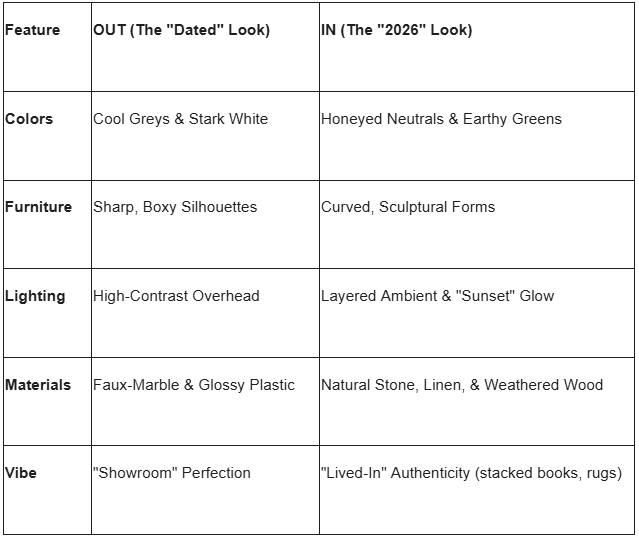
If your virtual staging catalog still looks like a 2021 IKEA catalog, your conversion rates will suffer. Here is the "In/Out" list for 2026 interior rendering:
5. Technical Excellence: Why "Quality" is a Local SEO Factor
Google's "Helpful Content" algorithms now analyze image quality and "User Experience" (UX). Low-resolution renders with "floating furniture" lead to high bounce rates, which kills your local ranking.
Perspective Matching: Ensure the furniture’s vanishing point matches the original photo’s camera lens (usually 16mm or 24mm for real estate).
Shadow Depth: 2026 AI rendering tools allow for "Contact Shadows." Without these, the furniture looks like a sticker on a photo.
Scale Accuracy: Use BIM (Building Information Modeling) standards to ensure that the 3D king-sized bed actually fits in the room physically.
Conclusion: Lead with Context, Not Just Content
In 2026, the most successful virtual staging companies aren't just "rendering factories"—they are demographic consultants. By matching your interior rendering style to the local culture, climate, and consumer psychology of your target area, you transform a simple photo into a powerful emotional narrative.
Don't just show them a room. Show them their life.
Ready to Localize Your Listings?
Our team at Q Real Estate Group specializes in GEO-targeted virtual staging that speaks the language of your local buyers. From the "Brownstone Chic" of Brooklyn to the "Modern Desert" of Scottsdale, we build the world your buyers want to live in.