$20k Staging Mistake: Virtual Staging for Property Developers
For decades, the "Physical Stage" was the gold standard. You finished the build, hired a crew, and watched as $15,000 to $30,000 of rental furniture was wheeled through the front door to sit in a silent room for three months.
In 2026, that isn’t just a tradition—it’s a leak in your balance sheet.
As real estate development margins tighten and the "digital-first" buyer journey becomes the only journey, the $20,000 physical staging invoice has become the ultimate "sunken cost." Today, we’re breaking down why physical staging is draining your budget and why smart developers are pivoting to AI-driven virtual staging to protect their ROI.
1. The Math of the $20,000 Leak
Let’s look at the cold, hard numbers. A typical staging contract for a 4-bedroom luxury home or a high-end condo development in 2026 looks something like this:
The Physical Staging Cost Breakdown
Consultation & Design Fee: $500 – $1,000
Delivery, Setup, and De-staging: $2,000 – $4,000
Monthly Rental (3-Month Minimum): $12,000 – $18,000
Insurance & Liability: $500 – $1,500
Total Average Spend: $15,000 – $24,500
Contrast this with AI-enhanced virtual staging. For a full property (8–10 high-resolution angles), a developer spends between $250 and $600.
The Verdict: You are paying a 4,000% premium for physical furniture that 96% of your buyers will only ever see on a smartphone screen.
2. The "Hidden" Costs You Haven’t Documented
The $20,000 check you write to the stager is only the beginning. Physical staging creates a domino effect of logistical friction that costs time—and in development, time is interest.
Carrying Costs & The "Dead Zone"
Every day a property sits empty while you wait for a staging crew to arrive is a day you are paying interest on your construction loan. Physical stagers often have lead times of 2–3 weeks. Virtual staging has a lead time of 24 hours.
Property Damage Liability
Moving heavy sofas and dining tables into a freshly painted, brand-new build is a recipe for scuffed floors and nicked drywall.
Physical: Requires a final "touch-up" crew after the furniture is removed.
Virtual: Zero footprints, zero scuffs, zero risk.
The "Single Style" Trap
When you physically stage, you pick one aesthetic (usually "Transitional" or "Modern"). If that style doesn't resonate with a specific buyer, you’re stuck. With virtual staging, you can generate three different interior styles (Scandinavian, Industrial, and Luxury) for the price of a single lunch, allowing you to A/B test your marketing.
3. Why the 2026 Buyer Doesn't Care About "Real" Furniture
The most common argument for physical staging is: "But buyers need to feel the space when they walk in."
Here is the 2026 reality: The "Walk-In" is a closing formality, not a discovery phase. According to recent NAR data, 96% of buyers start their search online, and 73% of those buyers decide whether or not to tour a home based entirely on the first five photos.
The Click-Through Rate (CTR) Advantage: Virtually staged listings see a 90% increase in engagement over empty rooms.
The Emotional Hook: AI staging in 2026 uses advanced light-path tracing and texture mapping. To the human eye on a screen, there is no longer a discernible difference between a $10,000 Italian leather sofa and a high-fidelity 3D render.
4. GEO & AI Search: How Virtual Staging Boosts Your SEO
This is the "Genius" part of the strategy. Virtual staging isn't just about pretty pictures; it’s about data.
Image Metadata and GEO-Tagging
When we deliver virtually staged assets, every file is optimized with local GEO-coordinates and alt-text that speaks directly to AI search engines (like Google’s Gemini and OpenAI’s SearchGPT).
Example: Instead of "LivingRoom.jpg," your image is tagged with "Modern luxury condo interior in [Your City], [Your Neighborhood], featuring open-concept floor plan."
AI Search Generative Experience (SGE)
AI search engines prioritize "comprehensive visual answers." When a user asks, "Show me new developments in [City] with mid-century modern interiors," AI crawlers look for visual proof. By virtually staging your development in multiple styles, you increase your chances of appearing in these specific, high-intent AI search results.
5. Maximizing ROI: The Developer’s Playbook
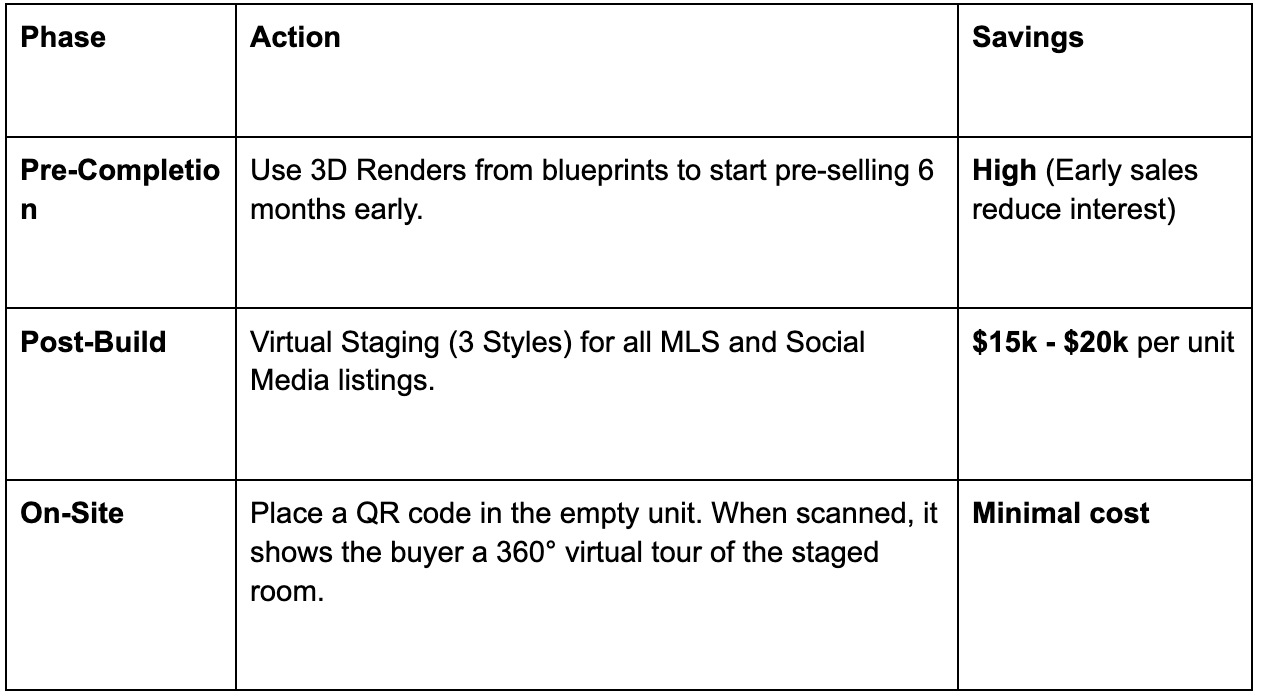
If you want to stop the $20,000 drain, follow this 3-step transition:
6. The Verdict: Physical is for the Past
Physical staging was a necessary evil when digital tools were clunky and "fake" looking. In 2026, the technology has surpassed the need.
By pivoting to virtual staging, you aren't just saving $20,000—you are gaining agility, market data, and a massive SEO advantage.
Stop draining your development budget on furniture rentals that sit in the dark. Invest that $20,000 back into your next land acquisition or a high-performance digital ad spend.
Ready to protect your margins?
Don't let your next project fall victim to the $20,000 mistake. Click here to see our 2026 Virtual Staging Portfolio and get a custom quote for your development in under 2 hours.