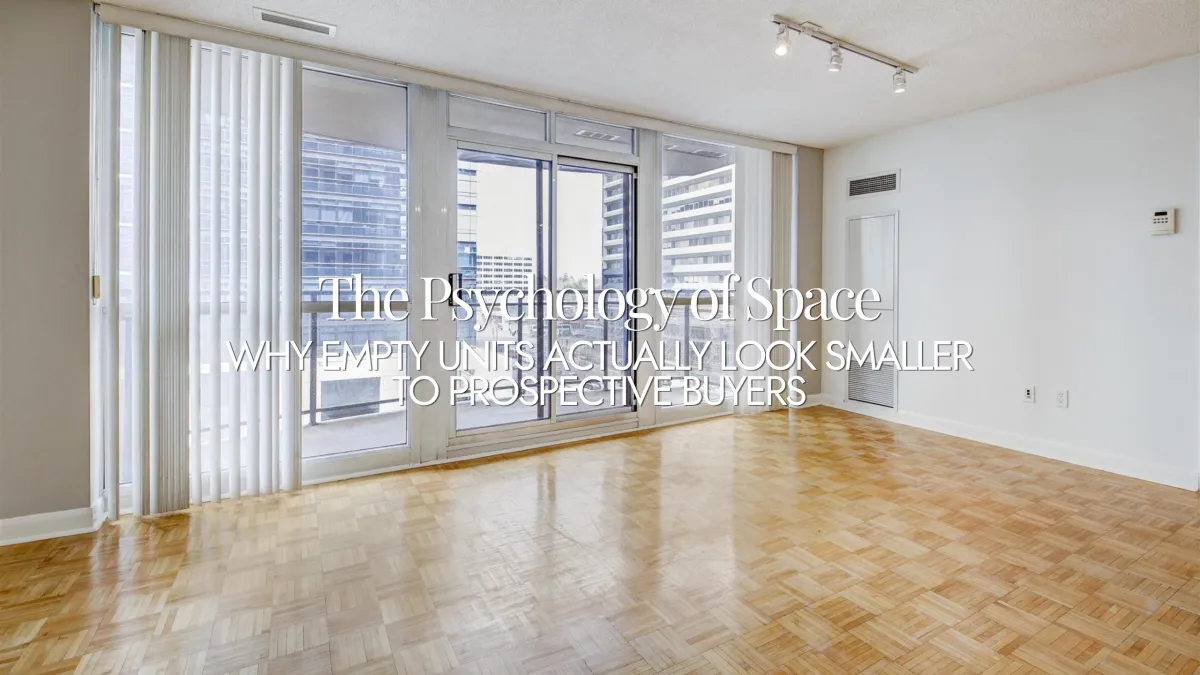
Why Empty Rooms Look Smaller: The Psychology of Virtual Staging
In the competitive world of real estate, there is a persistent myth that an "empty shell" allows buyers to see the full potential of a home. Sellers often assume that without the "distraction" of furniture, a room’s true dimensions will shine.
However, psychological research and spatial cognition studies suggest the exact opposite: Empty rooms almost always look smaller than staged ones.
For real estate professionals and developers, understanding the psychology of space is the difference between a listing that lingers for months and one that sells for a premium in days. This guide explores why the human brain struggles with empty squares, the cognitive biases at play, and how virtual staging leverages these psychological "hacks" to maximize perceived value.
1. The Reference Point Problem: Why the Brain Needs "Anchors"
The human visual system is not a laser measuring tape. We do not perceive distance or area in absolute terms; instead, we rely on comparative references to understand scale (Al-Zamil, 2017).
The Cognitive Gap
When a buyer walks into an empty 12x12 bedroom, they lack a "spatial anchor." Without a bed or a nightstand to serve as a known quantity, the brain loses its ability to accurately judge how much floor space is available. Paradoxically, an empty floor looks like a vast, undefined sea where it’s difficult to place a "king-sized bed" mentally.
Spatial Scaling
Research indicates that the arrangement of interior elements, such as furniture, creates visual illusions that alter our perception of spaciousness (Al-Zamil, 2017). By placing a bed in that same 12x12 room, you provide a scale. The buyer’s brain thinks: "The bed fits, and look how much room is left for a dresser and a chair." Without the furniture, the brain defaults to a conservative estimate, often leading the buyer to fear their furniture won't fit.
2. The "Ma" vs. "Lack" Perspective: Cultural Perception of Emptiness
How we perceive "empty space" is also deeply rooted in cultural psychology. In Western real estate markets, an empty room is often interpreted as an absence or lack rather than a "canvas of possibility."
The American Viewpoint: Research by Vartanian et al. (2015) suggests that while some cultures (like the Japanese concept of ma) see empty space as full of potential, American viewers tend to see it as "unfinished" or "missing" something.
The Emotional Chill: Empty spaces can trigger a "Minimalist Anxiety Response," where the brain experiences a simultaneous activation of the relaxation and stress responses. This "cold" feeling often translates to a lack of emotional connection to a property.
3. Geometric Proportions and the "Müller-Lyer Illusion"
Interior design utilizes geometric properties to influence mood and perception. Studies show that participants often experience higher positive affect and lower physiological arousal in spaces with curved or thoughtfully arranged furniture compared to stark, rectangular voids (Strachan-Regan & Baumann, 2024).
Breaking the Box
An empty room is just a series of 90-degree angles. This can lead to a "boxed-in" feeling. Staging breaks these lines. By introducing organic shapes (circular rugs, curved sofas, or even greenery), you soften the harsh geometry of the architecture, which research suggests can increase the "beauty judgments" and "approach-avoidance decisions" made by the brain (Vartanian et al., 2013).
4. The "Cognitive Load" of Mental Staging
Buying a home is one of the most high-stakes decisions a person will ever make. This creates a state of high cognitive load, where the brain is already overwhelmed by financial details, neighborhood stats, and future planning.
Asking a buyer to "imagine" where the furniture goes adds to this mental exhaustion. Behavioral economics teaches us that when people are overwhelmed, they default to simple heuristics (mental shortcuts) like "cluttered = cheap" or "empty = small" (Khalil-ur-Rehman et al., 2021).
The Power of Virtual Staging
Virtual staging removes the "imagination tax." By providing a fully realized vision of the home, you allow the buyer to move directly to the emotional evaluation phase.
Visual Clues: Physical (or virtual) environmental factors act as "physical clues" that buyers use to form opinions about the quality of a space (Khalil-ur-Rehman et al., 2021).
Aspiration over Calculation: Instead of calculating if a sectional will fit, the buyer begins imagining themselves drinking coffee in that specific armchair.
5. Focal Points and the "Stopping Power" of Design
In an empty room, the eye has nowhere to land. It wanders to the imperfections—the scuff on the baseboard, the slightly uneven window frame, or the texture of the drywall.
Staging creates focal points. By directing the eye toward a beautifully styled living area or a cozy reading nook, you control the "visual display fields" (METU Journal, 2025). This not only makes the room look larger by defining zones of activity but also increases the "stopping power" of your online listing photos.
Summary: The ROI of Spatial Psychology
The data is clear: spatial perception is subjective, not objective.
Empty rooms lack scale, leading buyers to underestimate square footage.
Furniture creates "anchors", allowing for faster, more positive cognitive processing.
Defined zones prevent the "boxed-in" feeling of raw architecture.
For modern real estate marketing, Virtual Staging is the most cost-effective way to bridge this psychological gap. It transforms a cold, "small" empty unit into a spacious, aspirational home where a buyer can finally see themselves living.