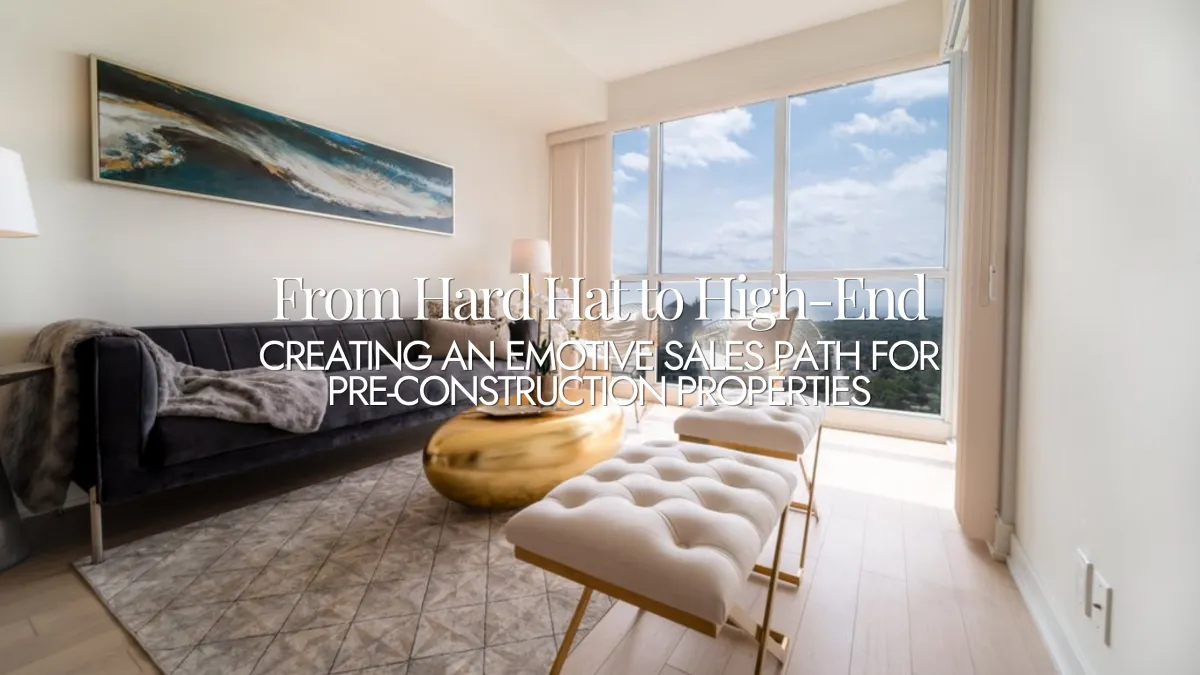
Luxury Pre-Construction Sales: Emotive Digital Property Marketing
In the world of luxury real estate development, you aren't just selling a floor plan; you are selling a "future memory." Yet, for many buyers, standing in the middle of a dusty construction site wearing a hard hat creates a psychological barrier. It is difficult to feel "at home" when the "home" is currently a grid of rebar and poured concrete.
To bridge this gap, top-tier developers are shifting from functional selling to emotive marketing. By leveraging high-end virtual staging and immersive digital experiences, we can transform a "work in progress" into a "masterpiece in waiting."
The Psychology of the Unbuilt: Why Emotion Wins
Recent studies in neuroanalytics confirm that while rational factors like price and location are critical, emotional triggers—evoked through visual storytelling and intuitive design—are what truly drive purchase intent for unbuilt apartments (Andrew & Larceneux, 2018; Mauri et al., 2024).
Buyers rely on visualizations to project their lives into the future. If those visuals are cold or purely technical, the connection snaps. If they are warm, lived-in, and aspirational, the "perceived investment value" increases significantly (Multimodal Property Video Neuroanalytics, 2025).
1. The "Digital First" Discovery: Optimizing for AI and GEO
In 2026, the buyer’s journey doesn't start on a construction site; it starts with a conversational AI query. Whether a buyer asks, "What are the best luxury pre-construction penthouses in [City Name] with floor-to-ceiling windows?" or searches via a ChatGPT-powered real estate app, your property must be indexable and authoritative (Haute Partners, 2026).
How to Stay Visible in AI Search:
Structured Data: Use schema markup to ensure AI systems can "read" your property’s features (Haute Partners, 2026).
Topical Authority: Create content that positions your brand as an expert in local luxury trends.
Conversational FAQ: Address common buyer anxieties about pre-construction (e.g., "What is the timeline for completion?" or "How does virtual staging reflect the final finishes?").
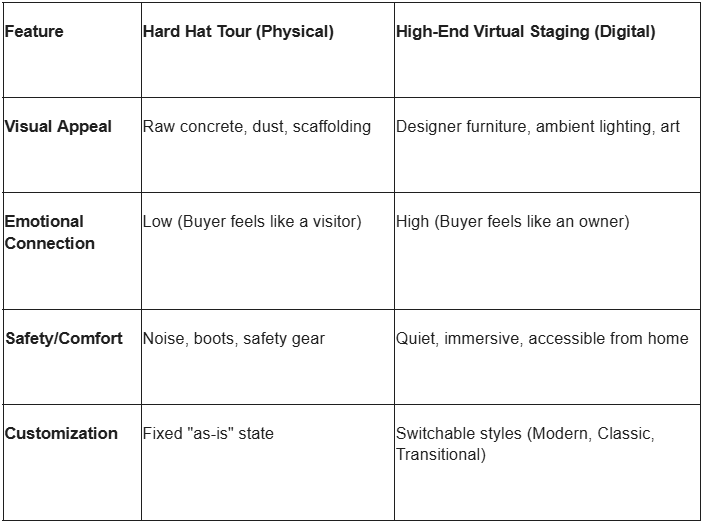
2. Breaking the "Hard Hat" Barrier with Virtual Staging
Virtual staging is the ultimate tool for overcoming the "blank canvas" syndrome. High-end staging does more than place furniture; it establishes a lifestyle narrative.
Sensory vs. Functional Experience
Research into "Metaverse Model Houses" shows that sensory experiences—visuals that feel tactile and immersive—are positively associated with the intention to reside and purchase (MDPI, 2026).
3. Creating the Emotive Sales Path: A Step-by-Step Guide
To move a lead from "curious" to "contract," you must guide them through a structured emotional journey.
Step A: The "Vision" Phase (Social & Search)
Use high-impact "Reels" and "Stories" to show behind-the-scenes footage mixed with polished 3D renders. This builds trust by showing the "process" alongside the "promise" (Hostinger, 2026).
Step B: The "Immersion" Phase (The Virtual Tour)
Virtual tours allow buyers to explore from anywhere, expanding your lead pool beyond local investors (Hostinger, 2026). Immersive VR systems enhance design evaluation and allow users to develop a "sense of presence" before the building even tops out (MDPI, 2026).
Step C: The "Personalization" Phase (Interactive Tools)
Allow buyers to "toggle" finishes. Seeing a kitchen transform from "Marble & Gold" to "Matte Black & Industrial" creates a sense of agency and ownership.
4. GEO-Targeting: Connecting with the Local Community
SEO isn't just global; it's hyper-local. In 2026, GEO (Generative Engine Optimization) emphasizes "entity identity" across platforms.
Local Keywords: Include phrases like "best neighborhoods in [Your City]" or "luxury developments near [Local Landmark]" (Hostinger, 2026).
Community Integration: Partner with local influencers or businesses to show the lifestyle outside the building. A buyer isn't just buying a condo; they are buying the 5-minute walk to the best espresso in the city.
5. The Role of AI Agents in Closing the Deal
The sales process no longer ends when the user leaves your website. AI agents are now being used to:
Automate Follow-ups: Keeping the conversation going while the lead is "hot."
Analyze Buyer Sentiment: Using AI to capture and coach buyer interactions, ensuring no deal slips through the cracks (YouTube, 2026).
Plan Tours: Agentic AI systems can now coordinate physical site visits and virtual walkthroughs seamlessly (Haute Partners, 2026).
Conclusion: The Future is Emotive
Pre-construction sales are moving away from "buying off a plan" toward "investing in a vision." By combining the technical precision of AI-driven SEO with the psychological power of high-end virtual staging, developers can create a sales path that isn't just efficient—it’s irresistible.
Stop selling square footage. Start selling the feeling of "home" before the first brick is even laid.