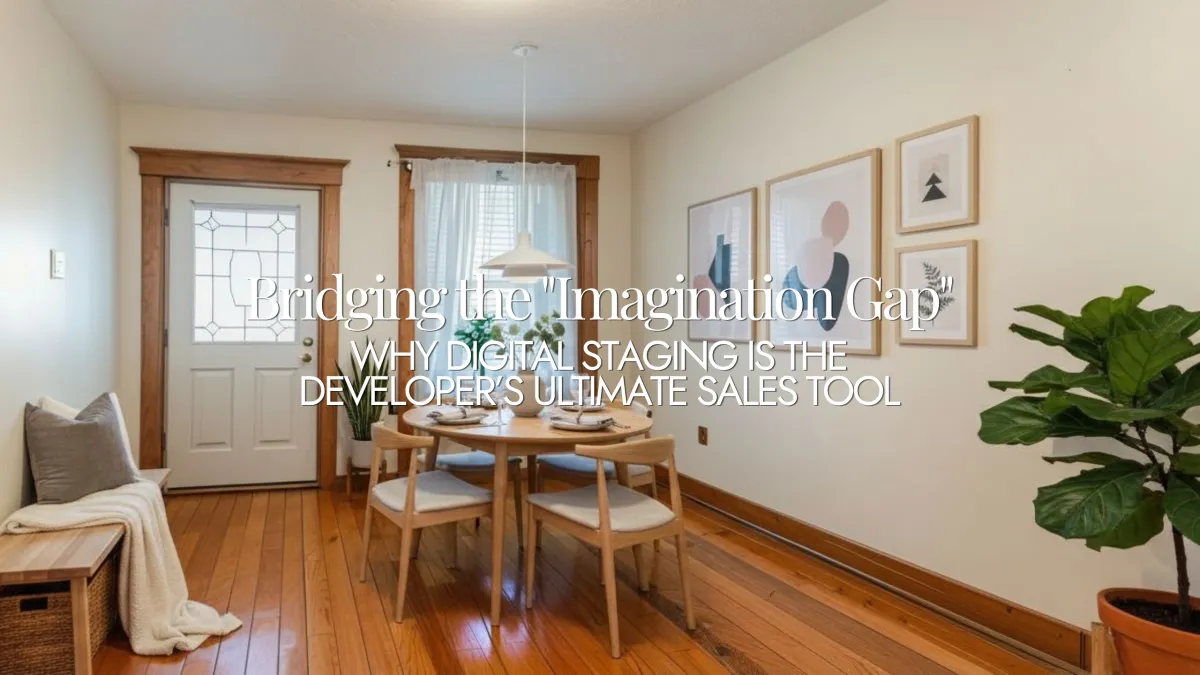
Digital Staging for Developers | Bridge the Imagination Gap & Pre-Sell
In the high-stakes arena of real estate development, the "Pre-Sale" is the holy grail. It de-risks the project, satisfies lenders, and builds momentum. But there is a fundamental psychological barrier that stops even the most interested buyers from signing a contract: The Imagination Gap.
When a buyer walks onto a construction site, they are greeted by the smell of sawdust, the sight of exposed plumbing, and the echo of an empty concrete shell. You are asking them to spend millions of dollars based on a floor plan and a "trust me."
In 2026, "trust me" is no longer a viable marketing strategy. To sell a lifestyle, you must show it. This guide explores how high-end digital staging outperforms traditional methods in bridging that gap and turning construction sites into sold-out developments.
I. The Psychology of the "Imagination Gap"
Why is it so hard to sell an empty room? The human brain is a remarkable organ, but it is notoriously poor at calculating scale and potential in a vacuum.
1. The "Shrinking" Effect
Empty spaces actually appear smaller to the naked eye. Without furniture to provide a reference point, the brain struggles to determine if a king-sized bed will fit or if the dining area can truly host a family of six. This creates "spatial anxiety," where the buyer’s primary emotion is doubt rather than excitement.
2. Cognitive Friction
Walking through a construction site requires a high "cognitive load." The buyer has to mentally filter out the debris, imagine the walls painted, and wonder where the light will hit at 4:00 PM. Digital staging removes this friction. It does the heavy lifting for the buyer, presenting a finished, polished reality that allows them to move straight to the emotional phase of the purchase.
II. Digital vs. Traditional Staging: The 2026 Comparison
For decades, physical staging—renting furniture, movers, and designers—was the only way to solve the imagination gap. Today, that model is increasingly seen as an outdated, high-risk liability.
1. The Cost-Benefit Breakdown
Physical staging for a mid-to-luxury unit in a major metro like New York or London can easily exceed $15,000–$30,000 for a 4-month contract. If the unit doesn't sell in that window? You're looking at monthly "holding fees" for the furniture.
Digital Staging offers a 95% reduction in cost while providing 100% of the visual benefit.
Physical: High overhead, insurance risks, potential for damage to the new floors.
Digital: Fixed cost, zero physical risk, and the ability to update the "look" as design trends shift.
2. Flexibility and "Style-Pivoting"
Imagine you’ve staged a unit in a "Minimalist Scandi" style with physical furniture. Two weeks later, your data shows that the primary interest is coming from families who prefer "Classic Traditional." With physical staging, you are stuck. With digital staging, we can swap the entire furniture set and color palette in 48 hours.
III. Selling a "Lifestyle," Not a Floor Plan
A floor plan tells a buyer where the bathroom is. A staged photo tells them how their life will improve. To bridge the gap, your digital visuals must focus on lifestyle triggers.
1. The "Active" Home
In 2026, buyers want to see themselves doing, not just being. We don't just place a sofa; we place a sofa with a textured throw blanket, a stack of high-end design books, and a tray with two cups of coffee. We create a "moment" that the buyer wants to inhabit.
2. The Remote Work Reality
No luxury development is complete without a dedicated workspace. We stage these areas to look professional yet integrated—showing that the "den" isn't just a leftover space, but a high-functioning executive office.
3. Indoor-Outdoor Flow
For units with balconies or terraces that are currently just concrete slabs with temporary railings, digital staging is essential. We show the outdoor kitchen, the lounge seating, and the lush greenery, effectively "expanding" the perceived square footage of the home.
IV. GEO-Targeting: Design That Speaks the Local Language
One of the most powerful SEO and sales strategies is Hyper-Local Design. A buyer in the Pearl District of Portland has a vastly different aesthetic preference than a buyer in South Beach, Miami.
Austin, TX: We lean into "Warm Modernism"—raw woods, leather accents, and industrial lighting.
Toronto, ON: We focus on "High-Rise Sanctuary"—maximizing light with reflective surfaces and soft, neutral palettes to combat gray winter days.
London, UK: We integrate "Modern Heritage"—pairing the sleek lines of a new build with classic architectural furniture that nods to the city's history.
By tailoring the digital staging to the specific "GEO-vibe" of the neighborhood, you aren't just selling a condo; you're selling a place in the community.
V. Strategic SEO for the Digital-First Buyer
In 2026, 98% of buyers start their journey on a screen. If your imagery isn't optimized, you aren't just losing "looks"; you're losing money.
1. Visual Search Optimization
Search engines now "read" images with incredible accuracy. By using high-resolution, photorealistic renders, your property is more likely to appear in "Visual Search" results. When someone searches for "Luxury kitchen with waterfall marble island," your staged image becomes your primary lead generator.
2. Metadata and Local SEO
Every staged image we provide is a container for local SEO data. By tagging images with specific neighborhood identifiers and "lifestyle" keywords (e.g., “Luxury-Penthouse-Living-Room-Yorkville-Toronto”), we ensure your development stays at the top of the search results for the highest-intent buyers.
VI. Overcoming the "Construction Site Stigma"
The biggest threat to a pre-sale is the buyer's fear of the unknown. "Will it look like the brochure?" "Is the quality actually there?"
High-end digital staging acts as a Quality Proxy. When a developer invests in photorealistic, high-fidelity visualizations, it signals to the buyer that the same level of care and precision is being applied to the physical construction. It builds professional credibility during the "messy" phase of the build.
VII. Conclusion: The Competitive Edge in 2026
The real estate market of 2026 is fast, visual, and unforgiving. Developers who rely on empty rooms and "imagination" will see their listings sit on the market while their interest rates climb.
Digital staging is the bridge. It takes the cold, hard reality of a construction site and transforms it into a warm, inviting, and inevitable future. It allows you to sell the lifestyle today, rather than waiting for the dust to settle tomorrow.
Don't let your project be a victim of the Imagination Gap. Let’s build the vision that gets the contract signed.
Expert FAQ (SEO Optimized)
Q: Can we stage common areas like lobbies and gyms?
A: Yes. In fact, staging common areas is often more important than the units themselves. It sets the "hospitality" tone of the entire building.
Q: How do we handle views if the building isn't finished?
A: We utilize high-altitude drone photography taken from the exact elevation of the specific floor to ensure the view in the window is 100% accurate to what the buyer will see.
Q: Is digital staging misleading?
A: Not at all. It is a visual representation of a finished product. We always recommend a small disclaimer ("Virtually Staged") to maintain total transparency while still providing the necessary visual context.